FACET WIRE PRICE GUIDE
Oval Diamond Guide: Prices, Ratios and the Bow-Tie Effect
Published 2026-11-02 · From live tracked listings
The oval is the engagement-ring shape of the moment: elongated, bright, and larger-looking than a round at the same carat weight. It is also the second most-tracked shape in Facet Wire's site catalog, 148,989 oval listings out of 1,044,080 live listings across 13 retailers, captured November 1, 2026. Of those, 132,221 are lab-grown (median $1,107, at a median of $477 per carat) and 16,768 are natural (median $2,137). Browse the full sets in oval lab-grown diamonds and natural oval diamonds.
Oval diamond prices by carat size
Median tracked prices in the site catalog captured November 1, 2026. Medians exclude listings under $100.
| Carat band | Lab-grown median | Lab listings | Natural median | Natural listings |
|---|---|---|---|---|
| Under 1 carat | $333 | 12,117 | $736 | 8,536 |
| 1 carat (1.00-1.09) | $429 | 13,155 | $3,064 | 2,134 |
| 1.5 carat (1.50-1.59) | $642 | 17,195 | $7,143 | 1,481 |
| 2 carat (2.00-2.09) | $967 | 11,963 | $14,839 | 878 |
| 3 carat (3.00-3.09) | $1,502 | 12,456 | $38,782 | 386 |
At 1 carat, a lab-grown oval's median is $429, and inventory is deepest exactly where buyers shop: 17,195 tracked lab listings sit in the 1.5-carat band alone. Natural ovals carry the usual natural premium, which grows sharply with size: at 3 carats the natural median is $38,782 against $1,502 lab-grown. For the wider elongated-shape picture, see Elongated Diamonds Are the Shape of 2026.
The bow-tie effect: the one thing the certificate won't tell you
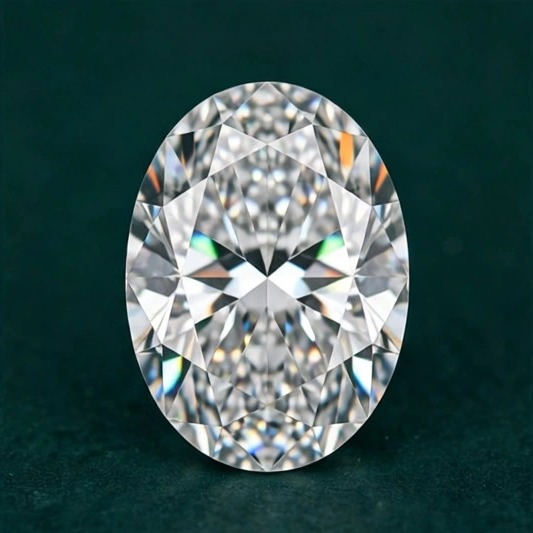
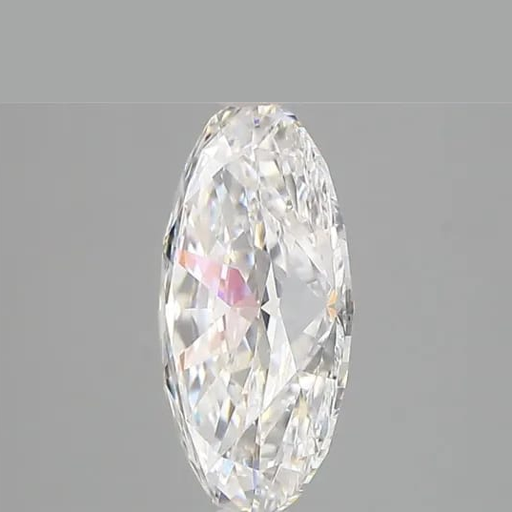
An oval's long shape can throw a dark shadow across its center, shaped like a bow tie, in some lighting. A faint bow-tie is normal; a heavy one makes the stone look dark in the middle from across a room. No certificate grade measures it. Two ovals with identical carat, color, clarity and cut grades can show it very differently, which is why an oval has to be judged on its actual photos and video before price even enters the conversation. If a listing only shows a stock image, treat that as a reason to ask for the real stone's media, or to look at a listing that has it.
Ratio, color and clarity for ovals
Ratio. Most buyers shop a length-to-width ratio around 1.30-1.50. Plumper ovals sit near the low end, slender ovals near the high end, and very long stones can make the bow-tie easier to see.
Color. Ovals tend to show their body color most at the two rounded ends, so a grade that looks colorless in a round can look warmer at an oval's tips. If the setting is white metal, that end color is the first place to check in photos.
Clarity. The oval's bright, busy sparkle hides small inclusions better than a step cut does, which gives buyers room to trade clarity grade for size or color, as long as the actual stone's media confirms nothing is visible to the eye.
Same stone, two prices: check before you buy
Deep inventory does not stop the same certified oval from being priced far apart. Facet Wire's Exact Matches pair stones by certificate number across retailers. In the current exact-match set, a 5.02-carat lab-grown oval (E color, IF clarity, IGI certificate 637453337) was $10,886 at Adiamor and $33,795 at New World Diamonds, a $22,909 spread for the same stone. A 4.55-carat lab-grown oval (D color, IF clarity) was $7,730 at Adiamor and $14,350 at New World Diamonds, a $6,620 spread.
Ovals are also the celebrity shape of the season on this site: see how a 3.5-carat oval engagement ring and a 4-carat oval halo ring price out against tracked stones. Before you buy, run any oval's certificate number and specs through Search and Check a Price, and keep an eye on the Price Index and the Lab vs Natural comparison.
Frequently asked questions
How much does a 1-carat lab-grown oval diamond cost right now?
In Facet Wire's site catalog captured on November 1, 2026, the median tracked price for a 1-carat (1.00-1.09 ct) lab-grown oval was $429 across 13,155 listings. The median for a 1-carat natural oval was $3,064 across 2,134 listings.
What is the bow-tie effect in an oval diamond?
The bow-tie is a dark shadow across the center of an elongated stone, shaped like a bow tie, that can appear in some lighting. It is not on the certificate - two ovals with identical grades can show it very differently - so it has to be judged from the stone's actual photos or video.
What length-to-width ratio is best for an oval diamond?
Most buyers look for a length-to-width ratio around 1.30 to 1.50. Lower ratios look rounder and plumper, higher ratios look longer and slimmer. It is a style choice, but very long ovals can make the bow-tie shadow easier to see.
Can the same oval diamond be listed at two very different prices?
Yes. Facet Wire's exact-match tracking pairs the same certified stone at multiple retailers. One tracked example: a 5.02-carat lab-grown oval, E color, IF clarity, IGI certificate 637453337, was listed at $10,886 at Adiamor and $33,795 at New World Diamonds - a $22,909 spread for the same stone.
How many oval diamonds does Facet Wire track?
148,989 oval listings in the site catalog captured on November 1, 2026: 132,221 lab-grown and 16,768 natural. Oval is the second most-tracked shape in the catalog, behind round.
Data: Facet Wire site catalog, live retailer listings tracked by Facet Wire (1,420,735 listings across 16 retailers, captured 2026-11-01). Medians exclude listings under $100. Prices are the retailers' listed prices at capture time.