FACET WIRE PRICE GUIDE
Pear Diamond Guide: Why Pears Are the Value Play Right Now
Published 2026-11-02 · From live tracked listings
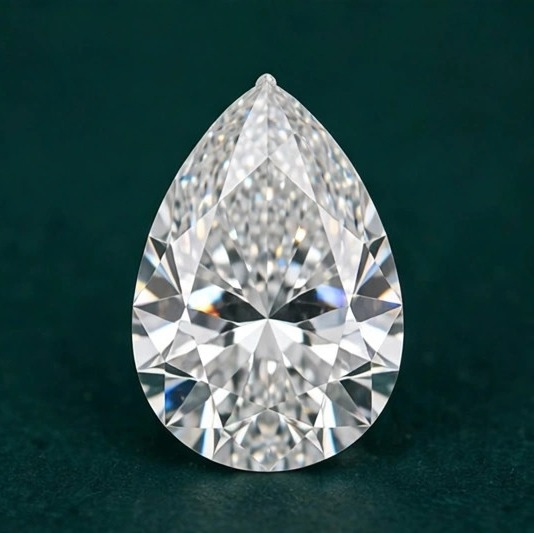
A pear diamond gives you two shapes in one: the rounded end of an oval and the pointed tip of a marquise. It is also, right now, one of the best value plays in the tracked market. Facet Wire's site catalog, 1,044,080 live listings across 13 retailers, captured November 1, 2026, holds 86,972 pear listings: 78,130 lab-grown and 8,842 natural. The median lab-grown pear costs $780, at a median of $446 per carat. The median natural pear costs $2,333. Start with the full set in pear lab-grown diamonds and natural pear diamonds.
Pear diamond prices by carat size
Median tracked prices in the site catalog captured November 1, 2026. Medians exclude listings under $100.
| Carat band | Lab-grown median | Lab listings | Natural median | Natural listings |
|---|---|---|---|---|
| Under 1 carat | $320 | 9,917 | $931 | 4,249 |
| 1 carat (1.00-1.09) | $406 | 12,107 | $3,133 | 1,902 |
| 1.5 carat (1.50-1.59) | $626 | 10,000 | $7,134 | 643 |
| 2 carat (2.00-2.09) | $934 | 7,075 | $14,304 | 477 |
| 3 carat (3.00-3.09) | $1,459 | 5,434 | $39,926 | 183 |
Two things stand out. First, lab-grown pears stay inexpensive as size climbs: the median only reaches $1,459 at 3 carats. Second, the natural premium explodes with size, at 2 carats the natural median is more than fifteen times the lab median in this catalog. The full lab-versus-natural picture is in our lab-grown vs natural price guide and the Lab vs Natural comparison.
Why pears are the value play
Three reasons, all visible in the numbers above. Pears are a fancy shape, and fancy shapes are priced below rounds at the same weight. The elongated outline spreads carat weight over a longer face, so a pear tends to look bigger than a round of the same carat weight. And inventory is deep, 86,972 tracked listings means real choice at every budget, which keeps pressure on prices. The cheapest tracked lab-grown pear at or above $100 in this catalog was a 0.32-carat D color, VS1 clarity stone at MiaDonna for $223.49.
What to watch when you buy a pear
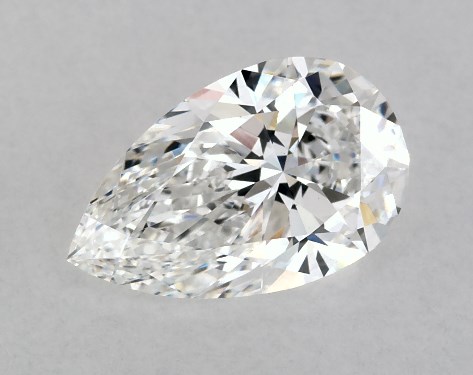
Ratio. Most buyers shop a length-to-width ratio around 1.40-1.70. Plumper or slimmer is a taste call, not a quality call.
Symmetry. Both sides of the curve should mirror each other, the tip should point straight, and the rounded end should not show a flat spot. A lopsided pear is visible the moment it is set.
The bow-tie. Like ovals and marquises, pears can show a dark bow-tie shadow across the middle in some light. It varies stone to stone, so judge the actual stone's photos and video, not just its grades.
The tip. The point is the most fragile part of the stone and the part most likely to show color. A V-prong setting protects the tip, and it is worth checking color grades carefully at the point.
Same stone, two prices: check before you buy
The strongest reason to compare is that the exact same certified pear can sit at two very different prices at the same time. Facet Wire's Exact Matches pair stones by certificate number across retailers. In the current exact-match set, a 2.00-carat natural pear (H color, SI1 clarity, GIA certificate 7546222591) was $12,143 at Adiamor and $22,100 at With Clarity, a $9,957 spread. A 4.10-carat lab-grown pear (D color, VVS1 clarity, IGI certificate 841662629) was $3,486 at Adiamor and $9,875 at With Clarity, a $6,389 spread. We have seen this pattern on pears before: see the Ritani vs Ada pear price gap.
Before you buy any pear, take its certificate number, shape, carat, color and clarity, and run it through Search and Check a Price. Then watch the broader market in the Price Index.
Frequently asked questions
How much does a 1-carat lab-grown pear diamond cost right now?
In Facet Wire's site catalog captured on November 1, 2026, the median tracked price for a 1-carat (1.00-1.09 ct) lab-grown pear was $406 across 12,107 listings. The median for a 1-carat natural pear was $3,133 across 1,902 listings.
Why do pear diamonds cost less per carat than round diamonds?
Pear is an elongated fancy shape, and fancy shapes are usually priced below round at the same carat weight. In the tracked catalog, lab-grown pears had a median of $446 per carat, and the elongated outline also tends to look larger face-up than its carat weight suggests.
What length-to-width ratio should I look for in a pear diamond?
Most buyers look for a length-to-width ratio around 1.40 to 1.70. Shorter ratios look plumper, longer ratios look more slender. Symmetry matters more than the exact ratio: both curved sides should mirror each other and the pointed tip should sit in line with the center of the rounded end.
Can the same pear diamond really be listed at two very different prices?
Yes. Facet Wire's exact-match tracking pairs the same certified stone at multiple retailers. One tracked example: a 2.00-carat natural pear, H color, SI1 clarity, GIA certificate 7546222591, was listed at $12,143 at Adiamor and $22,100 at With Clarity - a $9,957 spread for the same stone.
How many pear diamonds does Facet Wire track?
86,972 pear listings in the site catalog captured on November 1, 2026: 78,130 lab-grown and 8,842 natural, listed by 11 of the 13 retailers Facet Wire tracks.
Data: Facet Wire site catalog, live retailer listings tracked by Facet Wire (1,420,735 listings across 16 retailers, captured 2026-11-01). Medians exclude listings under $100. Prices are the retailers' listed prices at capture time.